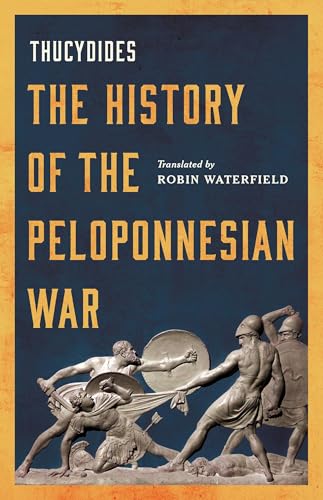
The Peloponnesian War
by Thucydides
"Book 2 / edited by J.S. Rusten"
Popularity
4.5 / 5
* A book's popularity is determined by how it compares to all other books on this website.
Where to buy?
Buy from Amazon* If you buy this book through the link above, we may receive a small commission at no extra cost to you.
The Peloponnesian War by Thucydides
Details
War:
Peloponnesian War
Perspective:
Researcher
True Story:
Yes
Biography:
No
Region:
Europe
Page Count:
280
Published Date:
1989
ISBN13:
9780521339292
Summary
The Peloponnesian War Book 2 covers the initial years of the devastating conflict between Athens and Sparta from 431 to 429 BCE. This volume includes Pericles' famous Funeral Oration, praising Athenian democracy and those who died in battle. It chronicles the plague that struck Athens, killing thousands including Pericles himself, and details military campaigns in various Greek territories. Thucydides provides analytical accounts of strategy, politics, and human nature during wartime. J.S. Rusten's edition offers scholarly commentary and contextualization of this crucial ancient historical text.
Review of The Peloponnesian War by Thucydides
Thucydides' account of the Peloponnesian War stands as one of the foundational texts of Western historiography, and Book 2, as edited by J.S. Rusten, offers readers an accessible entry point into this monumental work. This volume covers the critical opening years of the conflict between Athens and Sparta, providing insight into both the military campaigns and the political dynamics that shaped ancient Greece during one of its most turbulent periods.
Book 2 begins with the formal outbreak of hostilities in 431 BCE and extends through the first years of fighting, including the devastating plague that struck Athens. Thucydides, who lived through these events and served as an Athenian general, brings an eyewitness perspective to his narrative. His methodology represents a departure from earlier historical writing, as he emphasizes careful research, interviews with participants, and a critical examination of sources rather than relying on divine intervention or myth to explain human affairs.
The edition benefits significantly from J.S. Rusten's scholarly apparatus. The commentary provides essential context for readers navigating the complexities of ancient Greek warfare, politics, and society. Rusten's notes clarify geographical references, explain military terminology, and illuminate cultural practices that might otherwise remain opaque to modern audiences. This editorial work proves particularly valuable when approaching Thucydides' often dense prose and his tendency to assume reader familiarity with Greek customs and institutions.
Among the most significant portions of Book 2 is Pericles' Funeral Oration, delivered to honor the Athenian war dead after the first year of fighting. This speech presents an idealized vision of Athenian democracy and civic values, articulating principles of political participation, individual freedom within a collective framework, and the relationship between citizen and state. The oration has influenced political thought for centuries and remains widely studied in courses on rhetoric, political philosophy, and classical civilization. Thucydides' decision to include such speeches throughout his work, reconstructed based on what he believed was said or should have been said, represents an innovative historical technique that blends factual reporting with interpretive analysis.
The narrative of the plague that struck Athens in 430 BCE provides another crucial element of Book 2. Thucydides offers a clinical description of the disease's symptoms and progression, drawing on his own experience as a survivor. His account documents not only the physical effects of the epidemic but also its social and psychological impact on Athenian society. The breakdown of traditional burial practices, the collapse of social norms, and the atmosphere of despair and lawlessness that accompanied the plague all receive careful attention. This section demonstrates Thucydides' interest in how crisis reveals human nature and tests the stability of political institutions.
The military campaigns described in Book 2 showcase the strategic thinking of both sides as they adapted to a conflict that would eventually last nearly three decades. The Spartan invasions of Attica, the Athenian naval expeditions, and the various sieges and skirmishes illustrate the grinding nature of the war and the difficulty either side faced in achieving decisive victory. Thucydides presents these operations with attention to tactical detail while also considering their broader strategic implications and their effects on the civilian populations caught in the conflict.
Rusten's edition includes a Greek text alongside English translation, making it particularly useful for students developing their facility with ancient Greek. The introduction provides background on Thucydides' life, the historical context of the Peloponnesian War, and the literary characteristics of the work. This contextual material helps readers appreciate both the historical significance of the events described and Thucydides' role in shaping how subsequent generations would understand and interpret them.
The editorial choices reflect a balance between accessibility and scholarly rigor. The notes avoid overwhelming the reader with excessive detail while providing sufficient information to follow Thucydides' sometimes elliptical references and compressed narrative style. Cross-references to other sections of the History and to relevant ancient sources enable readers to pursue deeper investigation of particular topics or events.
This volume serves multiple audiences effectively. Students encountering Thucydides for the first time will find the supporting materials essential for navigating the text. Those with more advanced knowledge of ancient history can engage with the Greek text and appreciate the nuances of Thucydides' language and compositional techniques. The edition demonstrates how classical texts remain vital when presented with thoughtful editorial care that bridges the gap between ancient and modern readers while respecting the complexity and sophistication of the original work.