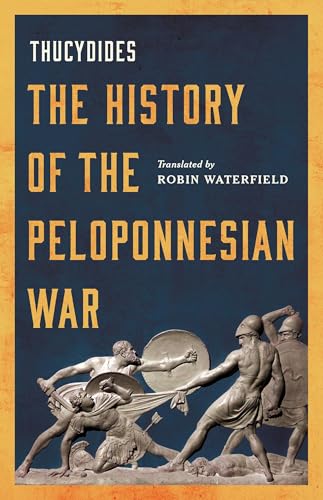
Thucydides
by Donald Kagan
"The Reinvention of History"
Popularity
4.5 / 5
* A book's popularity is determined by how it compares to all other books on this website.
Where to buy?
Buy from Amazon* If you buy this book through the link above, we may receive a small commission at no extra cost to you.
Thucydides by Donald Kagan
Details
War:
Peloponnesian War
Perspective:
Researcher
Biography:
No
Region:
Europe
Published Date:
2010
ISBN13:
9780143118299
Summary
Donald Kagan's "Thucydides: The Reinvention of History" examines the ancient Greek historian Thucydides and his groundbreaking work on the Peloponnesian War. Kagan, a distinguished classical scholar, analyzes how Thucydides transformed historical writing by emphasizing critical analysis, eyewitness testimony, and political realism over mythology and divine intervention. The book explores Thucydides' methodology, his influence on Western historiography, and his enduring relevance to understanding politics, war, and human nature. Kagan argues that Thucydides essentially invented a new approach to recording history that prioritized rational inquiry and evidence-based narrative, establishing standards that continue to shape historical scholarship today.
Review of Thucydides by Donald Kagan
Donald Kagan's "Thucydides: The Reinvention of History" stands as a comprehensive exploration of one of antiquity's most influential historians and his groundbreaking work on the Peloponnesian War. Kagan, a distinguished classical historian who spent decades studying ancient Greece, brings both scholarly rigor and accessible prose to this examination of Thucydides and his revolutionary approach to recording human events.
The book serves as both a biography of Thucydides and an analysis of his historical methodology. Kagan situates the ancient historian within his tumultuous context, examining how an Athenian general who experienced exile and witnessed the devastating conflict between Athens and Sparta came to write what many consider the first work of scientific history. Rather than attributing events to the whims of gods or fate, Thucydides sought rational explanations rooted in human nature, political ambition, and the dynamics of power.
Kagan's treatment of Thucydides' methodological innovations forms the core of this work. The ancient historian's commitment to accuracy, his critical examination of sources, and his attempts to understand causation marked a dramatic departure from earlier chronicle-style narratives. Thucydides distinguished between immediate causes and underlying factors, a analytical framework that remains relevant to historical study today. His famous examination of the difference between stated reasons for war and actual motivations demonstrates a sophisticated understanding of political psychology that transcends his era.
The book delves into specific episodes from Thucydides' history, including the Mytilenean Debate, the Melian Dialogue, and the disastrous Sicilian Expedition. Through these episodes, Kagan illustrates how Thucydides used carefully constructed speeches and narrative techniques to explore themes of justice, power, and imperial ambition. These set pieces serve not merely as historical records but as vehicles for examining enduring questions about statecraft and human behavior under pressure.
Kagan does not shy away from addressing scholarly debates surrounding Thucydides' work. Questions about composition dates, possible biases, and the accuracy of the speeches attributed to historical figures receive thoughtful consideration. The author acknowledges that while Thucydides claimed to adhere strictly to what was said, he also admitted to capturing the general sense of speeches rather than exact words. This tension between historical accuracy and narrative construction represents an ongoing challenge that historians continue to navigate.
One of the book's strengths lies in Kagan's ability to connect ancient historical writing to modern concerns. Thucydides' analysis of how fear, honor, and interest drive state behavior resonates in contemporary international relations theory. His examination of democracy under stress, the dangers of demagoguery, and the corrupting influence of power during wartime remains remarkably relevant. Kagan draws these connections without forcing anachronistic interpretations onto the ancient text.
The author also explores Thucydides' own experiences and how they shaped his historical perspective. Having held military command and suffered exile after a failed campaign, Thucydides possessed insider knowledge of Athenian politics and warfare. His removal from Athens paradoxically provided him access to both sides of the conflict and the distance necessary for more objective analysis. This unique position influenced both the scope and nature of his historical account.
Kagan addresses the structure and possible incompleteness of Thucydides' history, which ends abruptly in 411 BCE, several years before the war's conclusion in 404 BCE. Scholars have long debated whether Thucydides died before completing his work or whether other factors prevented its completion. These questions, while unresolved, provide insight into the challenges of ancient historical composition and transmission.
The book proves accessible to readers without extensive classical training while offering sufficient depth to engage those familiar with ancient Greek history. Kagan's prose remains clear and engaging throughout, avoiding unnecessary jargon while maintaining scholarly credibility. The work serves multiple audiences: students encountering Thucydides for the first time, scholars seeking fresh perspectives on familiar material, and general readers interested in the origins of historical writing.
"Thucydides: The Reinvention of History" ultimately succeeds in illuminating both its subject and his enduring significance. Kagan demonstrates how Thucydides transformed history from a simple record of events into a sophisticated analytical discipline. The ancient historian's influence extends far beyond classics departments, shaping how subsequent generations have understood causation, evidence, and the complex interplay between individual agency and broader historical forces. For anyone seeking to understand the foundations of historical thinking or the intellectual achievements of classical Athens, this book provides an invaluable guide to one of antiquity's most important and challenging texts.