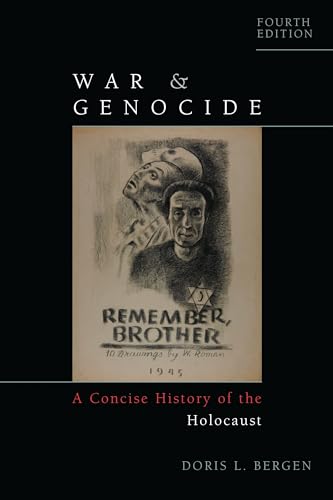
War and Genocide
by Doris L. Bergen
"A Concise History of the Holocaust"
Popularity
4.92 / 5
* A book's popularity is determined by how it compares to all other books on this website.
Where to buy?
Buy from Amazon* If you buy this book through the link above, we may receive a small commission at no extra cost to you.
War and Genocide by Doris L. Bergen
Details
War:
World War II
Perspective:
Researcher
True Story:
Yes
Biography:
No
Region:
Europe
Page Count:
441
Published Date:
2024
ISBN13:
9781538178072
Summary
War and Genocide provides a comprehensive examination of the Holocaust within the broader context of World War II. Doris L. Bergen traces the systematic persecution and murder of six million Jews and millions of others by Nazi Germany from 1933 to 1945. The book explores the origins of Nazi ideology, the implementation of genocidal policies, and the roles of perpetrators, victims, and bystanders. Bergen analyzes how war enabled genocide while examining the experiences of various targeted groups. This concise yet thorough history offers students and general readers an accessible introduction to understanding one of history's darkest chapters.
Review of War and Genocide by Doris L. Bergen
Doris L. Bergen's "War and Genocide: A Concise History of the Holocaust" stands as one of the most accessible yet comprehensive introductions to the systematic murder of six million Jews and millions of others during World War II. Originally published in 2003 and updated in subsequent editions, this work has become a standard text in university courses and a valuable resource for general readers seeking to understand one of history's darkest chapters.
Bergen, a distinguished professor of Holocaust Studies, approaches her subject with both scholarly rigor and remarkable clarity. The book's structure follows a chronological path while also addressing thematic elements that help readers grasp the complexity of the Holocaust. Rather than treating the genocide as an isolated phenomenon, Bergen carefully situates it within the broader context of Nazi ideology, European antisemitism, and the chaos of total war. This contextualization proves essential for understanding how such atrocities became possible.
The narrative begins by examining the roots of Nazi antisemitism and racial ideology, tracing the development of policies that progressively excluded Jews from German society during the 1930s. Bergen demonstrates how the Nazi regime moved from discrimination to persecution to mass murder through a series of incremental steps, each building on the last. This approach helps readers understand that the Holocaust was not inevitable but rather the result of specific choices, policies, and actions taken by individuals and institutions.
One of the book's greatest strengths lies in its attention to the experiences of victims. Bergen does not reduce the Holocaust to statistics and policy documents. Instead, she incorporates testimonies, diaries, and personal accounts that humanize those who suffered and perished. These individual stories provide emotional weight without overwhelming the historical narrative, creating a balance that respects both the victims' experiences and the need for analytical understanding.
The text also addresses the roles of perpetrators, bystanders, and collaborators with nuance and care. Bergen examines how ordinary people became involved in mass murder, whether through active participation, passive acceptance, or various forms of collaboration. This examination avoids simple moral judgments while still maintaining ethical clarity about the nature of the crimes committed. The book explores how factors such as careerism, peer pressure, ideological commitment, and situational circumstances influenced behavior during the genocide.
Bergen's treatment of resistance and rescue efforts adds important dimensions to the narrative. She discusses both Jewish resistance, which took many forms under impossible circumstances, and the efforts of non-Jews who risked their lives to help victims. These sections acknowledge the courage of those who acted while also explaining why such actions remained exceptional given the dangers involved and the pervasive antisemitism in occupied Europe.
The geographical scope of the work extends beyond Germany and Poland to examine the Holocaust across Nazi-occupied Europe. Bergen shows how the genocide played out differently in various regions, affected by local conditions, collaboration levels, and the presence or absence of established Jewish communities. This comparative approach reveals both the systematic nature of Nazi planning and the contingent factors that influenced outcomes in different locations.
The book's prose remains consistently clear and direct throughout. Bergen avoids unnecessary jargon while still maintaining academic standards. Complex historical debates receive attention without becoming bogged down in scholarly minutiae. This accessibility makes the book suitable for readers without prior background knowledge while still offering insights valuable to those more familiar with the subject.
Particularly valuable are Bergen's discussions of how historians have understood and interpreted the Holocaust. She addresses major historiographical debates without losing sight of her primary narrative goal. Readers gain awareness of how scholarly understanding has evolved while learning the fundamental historical facts.
The book also examines the aftermath of the Holocaust, including liberation, displaced persons, trials of war criminals, and the long-term impact on survivors. These final sections connect the wartime genocide to postwar efforts at justice and remembrance, providing necessary closure while acknowledging that such events cast long shadows.
Bergen maintains scholarly objectivity while never losing sight of the moral dimensions of her subject. The text presents historical evidence and analysis without minimizing the horror of what occurred. This balance between analytical distance and moral engagement makes the book both intellectually sound and emotionally resonant.
"War and Genocide" succeeds in its stated goal of providing a concise yet comprehensive history of the Holocaust. The book serves multiple audiences effectively, functioning as both an academic text and a general introduction. Bergen's clear writing, careful research, and humane approach to an inhumane subject create a work that educates without overwhelming and informs without desensitizing. For anyone seeking to understand the Holocaust, this book provides an excellent starting point and a solid foundation for further study.