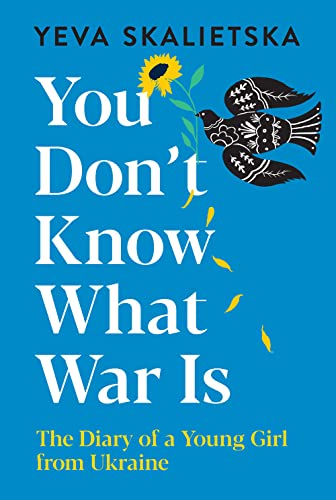
You Don't Know What War Is
by Yeva Skalietska
"The Diary of a Young Girl from Ukraine"
Popularity
4.87 / 5
* A book's popularity is determined by how it compares to all other books on this website.
Where to buy?
Buy from Amazon* If you buy this book through the link above, we may receive a small commission at no extra cost to you.
You Don't Know What War Is by Yeva Skalietska
Details
War:
Russo-Ukrainian War
Perspective:
Civilian
True Story:
Yes
Biography:
Yes
Region:
Europe
Published Date:
2022
ISBN13:
9781454949695
Summary
You Dont Know What War Is is the diary of twelve year old Yeva Skalietska, documenting her experiences during the 2022 Russian invasion of Ukraine. Written from her home in Kharkiv, one of the most heavily bombarded cities, Yeva records the fear, confusion, and daily realities of living under attack. She describes sheltering in basements, the sounds of explosions, and eventually fleeing to safety in Ireland with her grandmother. The diary offers a powerful, firsthand perspective of war through the eyes of a child, capturing both the horror of conflict and the resilience of the human spirit.
Review of You Don't Know What War Is by Yeva Skalietska
"You Don't Know What War Is: The Diary of a Young Girl from Ukraine" presents the firsthand account of Yeva Skalietska, a twelve-year-old girl living in Kharkiv when Russia launched its full-scale invasion of Ukraine in February 2022. The diary begins in the days before the war started, capturing the ordinary rhythms of a young girl's life, and then shifts abruptly as explosions and air raid sirens become part of daily reality. This transition from normalcy to crisis is one of the book's most striking features, illustrating how quickly life can change for civilians caught in the path of conflict.
The strength of this diary lies in its unfiltered, age-appropriate perspective. Yeva does not attempt to analyze geopolitics or offer commentary on military strategy. Instead, she records what she sees, hears, and feels: the sound of bombs, the fear of sleeping in a corridor away from windows, the disorientation of leaving home with only a small bag of belongings, and the long, uncertain journey to safety in Ireland. This simplicity gives the narrative an authenticity that more polished or analytical accounts of war often lack. Readers gain insight into how a child processes fear, loss, and displacement, and how she finds small moments of comfort, such as the presence of her grandmother, in the midst of chaos.
Structurally, the book follows a chronological diary format, which helps ground the reader in the immediacy of each day's events. This format works well for conveying the disorientation of wartime experience, as entries vary in length and tone depending on what is happening. Some entries are brief, almost matter-of-fact, while others reveal deeper emotional weight, particularly when Yeva writes about missing her home, her friends, and the life she once knew. The pacing mirrors the unpredictability of the situation itself, which adds to the book's emotional resonance without feeling manipulative or overly dramatized.
One of the book's notable achievements is its ability to convey a child's viewpoint without ever becoming saccharine. Yeva's observations are often unadorned in their honesty. She writes about war in terms that avoid abstraction, choosing instead to describe specific sensory details: the color of the sky during shelling, the crowded conditions of a shelter, the exhaustion of prolonged travel. This concreteness make the horrors of war tangible for readers who otherwise might only encounter these events through news reports or statistics. The diary format also allows for the inclusion of her original drawings and additional notes, which were reportedly included in the published edition, offering a visual complement to her written words.
While the book is undeniably moving, it maintains a measured tone throughout, avoiding sensationalism. Yeva does not dwell excessively on horror for its own sake, nor does she attempt to elicit sympathy through exaggeration. Instead, the diary reads as a genuine record of a specific period in her life, made all the more powerful by its restraint. This makes the book accessible to a wide range of readers, including younger audiences who may be approaching the topic of war for the first time, as well as adults seeking a personal, ground-level account of the conflict's early days.
The book also serves an important documentary function. As a primary source written by a child living through a significant historical event, it offers a perspective that complements journalistic and historical accounts of the Russian invasion of Ukraine. Its value lies not in providing analysis or context about the broader war, but in preserving one individual's lived experience during an unprecedented and destabilizing period.
Overall, "You Don't Know What War Is" succeeds in its aim to communicate the human cost of conflict through a young girl's eyes. It is a quietly powerful document, notable for its honesty and its refusal to editorialize. The diary format keeps the narrative grounded and immediate, while Yeva's voice remains consistently authentic throughout. For readers seeking to understand the personal impact of war, particularly through the perspective of a child, this book offers a valuable and unembellished account.


