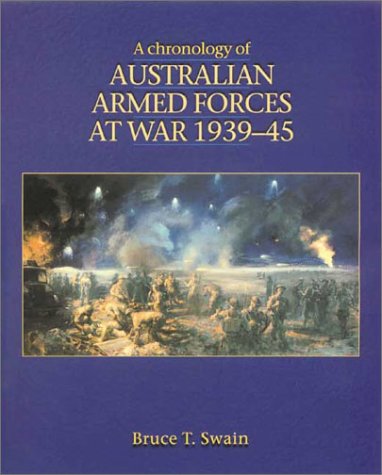
A Chronology of Australian Armed Forces at War 1939-45
by Bruce T. Swain
Popularity
1.54 / 5
* A book's popularity is determined by how it compares to all other books on this website.
Where to buy?
Buy from Amazon* If you buy this book through the link above, we may receive a small commission at no extra cost to you.
A Chronology of Australian Armed Forces at War 1939-45 by Bruce T. Swain
Details
War:
World War II
Perspective:
Researcher
True Story:
Yes
Biography:
No
Region:
Australia/Oceania
Page Count:
453
Published Date:
2001
ISBN13:
9781865083520
Review of A Chronology of Australian Armed Forces at War 1939-45 by Bruce T. Swain
Bruce T. Swain's "A Chronology of Australian Armed Forces at War 1939-45" offers a structured, reference-oriented approach to understanding Australia's military involvement during the Second World War. Rather than presenting a traditional narrative history, the book organises its content chronologically, tracking the movements, deployments, and engagements of Australian army, navy, and air force units across the six years of global conflict. This format positions the work as a practical tool for researchers, students, and enthusiasts seeking to establish timelines and cross-reference events with precision.
The scope of the book is considerable, given the geographical breadth of Australia's wartime contribution. Australian forces served across multiple theatres, including the Middle East, North Africa, Greece, Crete, and the extensive Pacific campaigns following Japan's entry into the war in December 1941. Swain's chronological method allows readers to trace how Australian units transitioned between these theatres, reflecting the shifting strategic priorities that shaped Australia's military commitments throughout the war. The fall of Singapore in February 1942 and the subsequent redirection of Australian resources toward the defence of the Pacific region represent one of the pivotal shifts documented within this kind of chronological framework.
One of the strengths of a chronology-based approach is its utility as a reference work. For those researching specific units, battles, or periods, the ability to locate events by date rather than searching through a continuous narrative can save considerable time. This format also lends itself well to cross-referencing with other historical sources, official records, and personal accounts, making it a valuable companion piece for more detailed historical research rather than a standalone narrative history.
The book's organisation by branch of service—army, navy, and air force—alongside its chronological structure suggests an effort to capture the interconnected nature of Australia's military effort. This tri-service perspective is important, as it reflects the reality that Australia's war effort was not confined to any single branch but involved coordinated action across land, sea, and air forces, often in support of Allied operations under British or American command structures.
Readers should approach this book with an understanding of its purpose as a chronological reference rather than an analytical or interpretive history. Those seeking deep contextual analysis, personal testimonies, or extensive discussion of strategic decision-making may find the format limiting. The strength of the work lies not in storytelling but in its systematic documentation of when and where Australian forces were engaged throughout the war years.
For students of military history, genealogists tracing family members who served, or researchers compiling detailed studies of specific campaigns, this chronology serves as a foundational reference point. It provides the skeletal structure of dates and deployments upon which more detailed research can be built. The value of such reference works often becomes apparent when used in conjunction with unit histories, official war diaries, and firsthand accounts, where the chronological framework helps situate individual experiences within the broader timeline of the conflict.
The period covered, 1939 to 1945, encompasses the entirety of Australia's involvement in the Second World War, from the declaration of war following Britain's entry in September 1939 through to the Japanese surrender in August 1945. This comprehensive timeframe ensures that the chronology captures the full arc of Australia's military commitment, from initial deployments to the Middle East through to the final campaigns in the Pacific and the eventual peace.
Overall, "A Chronology of Australian Armed Forces at War 1939-45" fulfils a specific and useful function within the broader landscape of Australian military history literature. It is not designed to compete with narrative histories that explore the human dimensions of war, but rather to complement them by providing a reliable factual backbone. For anyone engaged in serious research into Australia's wartime experience, this chronological approach offers a methodical and accessible means of establishing the sequence of events that shaped the nation's contribution to the Allied war effort.