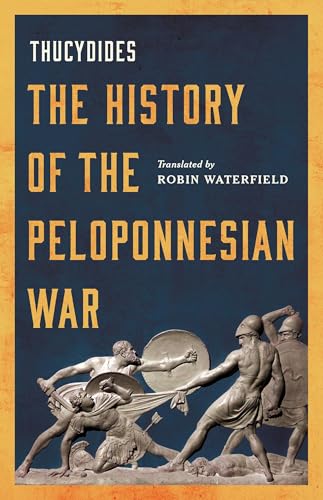
The History of the Peloponnesian War
by Thucydides
Popularity
4.97 / 5
* A book's popularity is determined by how it compares to all other books on this website.
Where to buy?
Buy from Amazon* If you buy this book through the link above, we may receive a small commission at no extra cost to you.
The History of the Peloponnesian War by Thucydides
Details
War:
Peloponnesian War
Perspective:
Researcher
Biography:
No
Region:
Europe
Published Date:
2025
ISBN13:
9781541603387
Summary
The History of the Peloponnesian War is Thucydides' account of the devastating 27-year conflict between Athens and Sparta from 431 to 404 BCE. As both historian and participant, Thucydides chronicles the war's causes, major battles, and political developments with rigorous attention to accuracy. The work examines themes of power, democracy versus oligarchy, and human nature during wartime. Notable sections include Pericles' Funeral Oration and the disastrous Sicilian Expedition. Thucydides pioneered evidence-based historical writing, distinguishing his work from mythological traditions. The narrative remains unfinished, ending in 411 BCE.
Review of The History of the Peloponnesian War by Thucydides
Thucydides' "The History of the Peloponnesian War" stands as one of the foundational texts of Western historiography and political thought. Written in the fifth century BCE, this detailed account chronicles the devastating conflict between Athens and Sparta that engulfed the Greek world from 431 to 404 BCE. The work demonstrates a methodological rigor and analytical depth that distinguishes it from earlier historical narratives and establishes standards for historical writing that remain influential more than two millennia later.
The author, an Athenian general who was exiled after failing to prevent the Spartan capture of Amphipolis in 424 BCE, brought unique insights to his subject matter. This military experience and political exile paradoxically provided advantages for his historical work. The exile allowed access to both sides of the conflict and removed him from the immediate pressures of Athenian politics, enabling a more detached perspective on events. Thucydides explicitly states his intention to create a work that would be useful for understanding human nature and political behavior in perpetuity, rather than simply entertaining contemporary audiences.
The narrative structure follows a largely chronological approach, organized by summers and winters of each year of the war. This meticulous attention to chronology reflects the author's commitment to precision and factual accuracy. Throughout the text, Thucydides demonstrates a skeptical approach to sources, distinguishing between eyewitness accounts and hearsay, and openly acknowledging the difficulties of establishing certain facts. This critical methodology represents a significant departure from the more mythologically influenced histories of his predecessors.
One distinctive feature of the work is its inclusion of speeches delivered by various political and military leaders. These rhetorical set pieces, including the famous Funeral Oration of Pericles and the Melian Dialogue, serve multiple purposes within the narrative. Thucydides acknowledges that exact reconstruction of these speeches was impossible, but maintains that he aimed to capture what was actually said while ensuring the speeches addressed the situations at hand. These passages provide insight into the political arguments, strategic considerations, and moral reasoning that shaped decision-making during the conflict.
The analysis of power politics throughout the work has ensured its enduring relevance to international relations theory. Thucydides examines how fear, honor, and interest motivate states and individuals, exploring the tension between justice and expediency in political affairs. The Melian Dialogue, in which Athenian representatives argue that the strong do what they can while the weak suffer what they must, presents a stark articulation of realist principles in international relations. This unflinching examination of power dynamics continues to provoke discussion among scholars of politics and ethics.
The portrayal of the plague that struck Athens early in the war demonstrates the author's observational powers and willingness to describe events in clinical detail. The account of the disease's symptoms, its social effects, and the breakdown of traditional customs and morality under extreme stress provides valuable historical evidence while also serving as a meditation on how crisis reveals human character. This episode exemplifies the work's broader interest in how war affects societies beyond the battlefield.
Thucydides' analysis of stasis, or civil strife, particularly in his account of events in Corcyra, offers penetrating observations about how war exacerbates internal divisions within communities. The description of how political factions escalate conflicts, language becomes corrupted, and moderate voices are silenced speaks to universal patterns of social breakdown. These passages demonstrate an interest in psychology and sociology that extends the work's scope beyond military history.
The text remains unfinished, breaking off in 411 BCE, several years before the war's conclusion. Various explanations for this incompleteness have been proposed, including the possibility that Thucydides died before completing his project. Despite this truncation, the existing work provides comprehensive coverage of the war's first two decades and the complex factors that drove the conflict.
Modern readers approaching this ancient text should recognize both its achievements and its limitations. The focus remains primarily on military and political affairs, with limited attention to economic factors, daily life, or the experiences of non-elite populations. The perspective is predominantly that of the male citizen class of Greek city-states. Nevertheless, within its chosen scope, the work achieves remarkable analytical sophistication.
"The History of the Peloponnesian War" rewards careful reading with its complex portrait of human behavior under the pressures of prolonged conflict. Its influence extends across disciplines, shaping not only historical methodology but also political theory, military strategy, and international relations. The work's combination of detailed factual narrative with philosophical reflection on the patterns underlying events creates a text that functions simultaneously as historical record and theoretical treatise. For readers interested in the origins of historical thinking, the classical world, or the enduring problems of war and politics, Thucydides offers insights that retain their power across the centuries.


