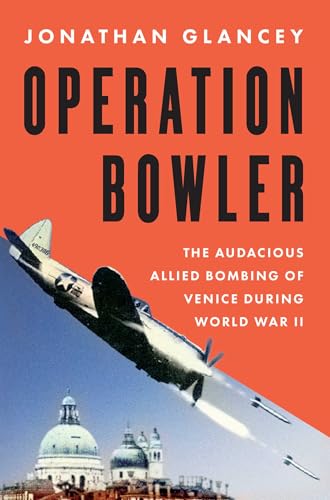
Operation Bowler
by Jonathan Glancey
"The Audacious Allied Bombing of Venice during World War II"
Popularity
4.8 / 5
* A book's popularity is determined by how it compares to all other books on this website.
Where to buy?
Buy from Amazon* If you buy this book through the link above, we may receive a small commission at no extra cost to you.
Operation Bowler by Jonathan Glancey
Details
War:
World War II
Perspective:
Bombers
Military Unit:
Royal Air Force
True Story:
Yes
Biography:
No
Region:
Europe
Published Date:
2025
ISBN13:
9781639369195
Summary
Operation Bowler chronicles a lesser-known World War II episode when Allied forces considered bombing Venice, one of the world's most culturally significant cities. Jonathan Glancey examines the strategic military reasoning behind targeting Venice's infrastructure, including its marshalling yards and industrial facilities, while exploring the ethical dilemma of potentially destroying irreplaceable Renaissance architecture and art. The book reveals the tensions between military necessity and cultural preservation, detailing how Allied planners wrestled with balancing tactical objectives against the risk of damaging humanity's shared heritage. Glancey draws on archival research to illuminate this controversial chapter in wartime decision-making.
Review of Operation Bowler by Jonathan Glancey
Jonathan Glancey's "Operation Bowler" examines a little-known episode of the Second World War: the Royal Air Force's precision bombing raid on Venice in March 1945, targeting the German-occupied port and rail facilities without damaging the city's historic fabric. The book's title refers to the codename given to this mission, and Glancey uses it as a lens through which to explore broader questions about the ethics, logistics, and legacy of aerial warfare in urban, culturally significant environments.
Glancey, an architecture and design writer known for his work on aviation and cultural history, brings a distinctive sensibility to this subject. Rather than treating the raid as a mere military footnote, he situates it within the larger context of Allied strategy in Italy during the final months of the war, the shifting priorities of bomber command, and the delicate calculations required to strike German logistics while sparing Venice's canals, bridges, and centuries-old architecture. The book benefits from Glancey's evident fascination with technical detail, particularly regarding the aircraft involved, the training required for such a precise operation, and the coordination between reconnaissance, planning, and execution that made the raid possible.
One of the book's strengths lies in its attention to the human dimension of the mission. Glancey profiles the pilots and planners tasked with threading a needle: destroying strategic targets while avoiding one of the most architecturally and culturally significant cities in the world. This focus on individual decision-making under pressure gives the narrative a personal dimension that might otherwise be lost in a purely strategic account. Readers get a sense of the anxiety and responsibility felt by those involved, aware that a single miscalculation could have resulted in irreversible damage to Venice's heritage.
Glancey also situates the raid within the wider history of Allied efforts to protect cultural monuments during the war, a subject that has received increasing attention in recent decades. The book touches on the tension between military necessity and cultural preservation, a theme that resonates beyond this specific operation. While Operation Bowler was ultimately successful in its stated aims, Glancey does not shy away from acknowledging the inherent risks and moral complexities of bombing campaigns, even those conducted with unusual care.
The writing style is accessible without sacrificing depth. Glancey avoids dense military jargon, making the technical aspects of the raid understandable to readers without specialized knowledge of aviation history. At the same time, the book does not oversimplify; it engages seriously with the strategic context of the Italian campaign in early 1945, the German occupation of northern Italy, and the broader Allied bombing strategy that had, by that point in the war, evolved considerably from earlier, less discriminate approaches.
Structurally, the book moves at a steady pace, balancing narrative momentum with the necessary historical background. Some readers may find the level of technical detail regarding aircraft and flight paths more suited to specialists, though Glancey generally manages to keep this material in service of the larger story rather than allowing it to overwhelm the narrative. The inclusion of contextual material about Venice itself, its wartime situation, and the stakes involved in protecting it adds richness to the account.
"Operation Bowler" succeeds as both a focused military history and a meditation on the value societies place on cultural heritage even amid the destructive logic of war. Glancey's approach avoids sensationalism, instead offering a measured account that respects the complexity of the historical record. The book will appeal to readers interested in World War II aviation history, the Italian campaign, and the broader question of how armed conflict intersects with the preservation of cultural landmarks.
For those interested in lesser-known chapters of the Second World War, particularly ones that highlight the intersection of military strategy and cultural stewardship, this book offers a worthwhile and carefully researched account. It adds a valuable case study to the literature on Allied bombing campaigns, distinguishing itself through its specific focus on the deliberate effort to spare a city of immense historical and artistic significance from the broader devastation of aerial warfare.