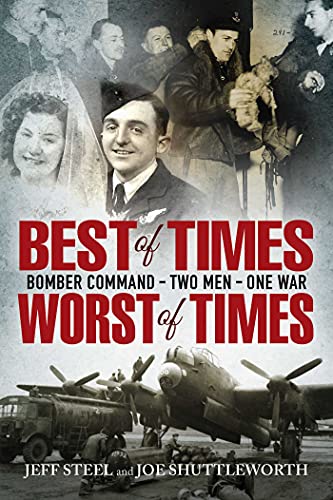
Best of Times, Worst of Times
by Jeff Steel
"Bomber Command, Two Men, One War"
Popularity
2.94 / 5
* A book's popularity is determined by how it compares to all other books on this website.
Where to buy?
Buy from Amazon* If you buy this book through the link above, we may receive a small commission at no extra cost to you.
Best of Times, Worst of Times by Jeff Steel
Details
War:
World War II
Perspective:
Bombers
Military Unit:
Royal Air Force
True Story:
Yes
Biography:
Yes
Region:
Europe
Page Count:
360
Published Date:
2021
ISBN13:
9781922488817
Review of Best of Times, Worst of Times by Jeff Steel
Jeff Steel's "Best of Times, Worst of Times: Bomber Command, Two Men, One War" approaches the story of RAF Bomber Command through the experiences of two individuals whose paths were shaped by the same conflict but who occupied very different positions within it. Rather than offering a sweeping institutional history, the book narrows its focus to personal narrative, using the lives of these two men as a lens through which broader questions about duty, survival, and the machinery of war can be examined. This structural choice gives the book its title, suggesting a duality that runs throughout the text: moments of camaraderie and purpose set against the grim realities of loss and fear that defined service in Bomber Command during the Second World War.
Bomber Command has long occupied a complicated place in British wartime memory. The strategic bombing campaign against Germany was costly in both human and moral terms, and the men who flew these missions faced extraordinarily high casualty rates. Steel's decision to anchor his narrative in the lived experience of two men allows the book to avoid becoming purely a recitation of statistics or strategic debates. Instead, readers encounter the day-to-day realities of service: the training, the waiting, the missions themselves, and the psychological toll that repeated exposure to danger exacted on those involved.
The book's structure, moving between two distinct perspectives, offers a useful device for illustrating how the war was experienced differently depending on role, rank, or circumstance. This dual narrative approach can be particularly effective in military history, as it resists the temptation to present a single, uniform account of what was in reality a deeply varied and individual experience for those who served. By keeping the focus tight on two men rather than attempting a comprehensive survey, Steel is able to render their experiences with a degree of detail and immediacy that broader histories sometimes sacrifice for scope.
Readers interested in aviation history, wartime memoir, or the specific operational history of Bomber Command will likely find much to engage with here. The book sits within a well-established tradition of personal-history writing about the Second World War, a genre that has produced many valuable accounts precisely because it grounds abstract historical events in individual human experience. Steel's contribution to this tradition lies in his ability to weave together two separate threads into a coherent narrative, allowing comparisons and contrasts to emerge naturally from the material rather than being imposed through heavy authorial commentary.
One of the strengths of this kind of dual-biography approach is its capacity to humanise historical events that might otherwise remain distant or abstract. Casualty figures for Bomber Command are staggering, and it can be difficult for readers removed by decades from the war to fully grasp what those numbers meant in practice. By following two specific individuals through their service, the book offers a way of understanding those losses and risks on a more comprehensible scale. This is not a novel technique in military history writing, but it remains an effective one when executed with care and attention to detail.
At the same time, the reliance on personal narrative means the book's scope is necessarily limited. Readers seeking a comprehensive strategic overview of the bombing campaign, its planning, or its long-term consequences for postwar Europe may need to look elsewhere or treat this book as a complement to more broadly focused histories. What Steel offers instead is a more intimate portrait, one that trades breadth for depth and strategic analysis for personal testimony.
The title's reference to "best of times, worst of times" captures something essential about wartime service more generally: the coexistence of intense bonds formed under pressure alongside the trauma and loss that accompanied combat operations. This duality is likely to resonate with readers familiar with other accounts of wartime service, where moments of genuine connection and purpose often sit uneasily alongside profound suffering.
Overall, this book represents a considered addition to the literature on Bomber Command, distinguished by its focus on two specific individuals rather than an attempt at comprehensive coverage. Those with an interest in personal wartime narratives, or in the specific experiences of RAF bomber crews, will find a carefully constructed account that balances the human and historical dimensions of its subject matter with evident care.